
 홈 > 뉴미디어대안영화제 홈 > 뉴미디어대안영화제 |
| 광화문 풍경 Gwanghwamun Still Life |
 |
 |
 |
|||
 |
|
 |
|||
 |
 |
 |


X Program
- 아트스페이스오 Artspace O
8.17 ~ 8.25, 11:00 - 19:00 (8.17, 8.25 17:00까지)
*도슨트 전시해설 : 일 2회 (오후3시, 5시)
Artist's Statement
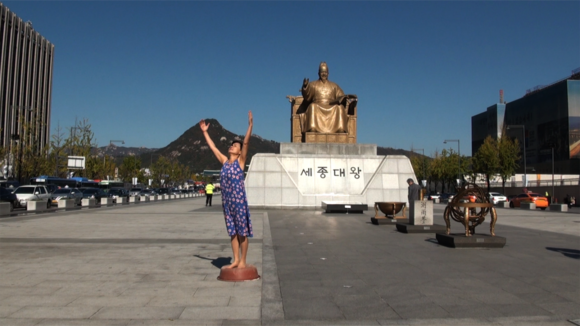
광화문 앞, 이곳은 중, 고등학교를 다닐 때 매일 지나다니던 곳이니 내겐 아주 익숙한 공간이다. 이미 많은 사람들의 놀이터이기도 하다. 이순신장군상이 있고 미 대사관이 있고 그땐 없었지만 세종대왕상이 있고, 관광객들이 있다. 이곳에서 여러 포즈로 사진을 찍고 ‘한국’을 감상한다. 장애등급제를 폐지하라 시위를 하는 사람도 있고 기독교를 믿으라 있는 대로 크게 외치며 지나가는 차도 있다. 풍경은 늘 움직인다. 움직이는 풍경에는 틈이 있게 마련이다. 겹쳐있는 공간 사이사이에 얇은 금이 가서 그 틈이 점점 벌어지는 것이 보인다. 그것이 내가 들어갈 수 있을 만한 크기가 되었을 때 나는 그 틈으로 잽싸게 들어간다. 얼른 사진을 찍고, 도로 나와 그 틈을 여민다. 광장 풍경의 이면에 수없이 존재하는 중층의 공간들이 매혹적이다. 그 다른 공간에로의 ‘벌어짐’들이 있기에 우리는 또 다른 삶을 꿈꿀 수 있다.
In front of Gwanghwamun, this is a place I used to pass by every day when I was in middle and high schools, so it is a very familiar space for me. It is already a playground for many people. There are a statue of Admiral YI Sunsin, an Embassy of the United States, and a statue of King Sejong that has been newly built, as well as tourists. I take pictures in various poses here and enjoy 'Korea'. There are people who protest the abolition of the disability rating system and Christians in a car exclaiming, “Believe in Christianity” Landscapes always move. There is a gap in the moving landscapes. The thin cracks between overlapping spaces show that the cracks are getting wider. When it comes to the size that I can get in, I get into that gap quickly. I take a picture, and I get out of the gap then fill it again. The middle spaces that are numerous in the back of the Square’s landscape are fascinating. We can dream another life because there are 'gaps' toward other space.
 |
홍이현숙 홍이현숙은 1958년, 대한민국 경상북도 점촌 산골마을 출생이며 대학에서는 조각을 전공했고 현재 서울에 거주하며 작업하고 있다. 잘 안 보이는 것들, 사이에 있는 것들, 혹은 보려 하지 않는 것들을 드러내고자 하는 ‘은닉된 에너지'(1995, 미술회관)시리즈로 시작하여 장소와 몸(사람, 동물, 사물)을 유비하는 설치작업(국립극장계단 1997, 인사동 육교2000, 통일전망 2002)을 주로 하였다. 2005년 대안공간 풀에서의 개인전부터, 영상작업을 통해 작가자신의 몸이 어떤 특정한 장소, 특정한 시간과 직접 만나는 풍경을 그리기 시작하였다. 주요영상작업으로는 <Picketing(2017)>, <사자자세>(2017),<폐경의례(2013)>,<Away(2011)>, <북가좌 엘레지(2009)>, Body Rolling(2006)>이 있다.최근 몇 년 동안 위안부를 주제로 한 영상작업을 하면서, 위안부 문제와 근대국가, 식민시대, 성폭력 등의 문제와 새롭게 만났다. <우리집에 왜왔니 1,2>, <조촐한 추모>가 있다. |
Hong Lee Hyun Sook Hong Lee, Hyun-Sook was born in the mountain village of Jeomchon in Gyeongsangbuk-do, Korea in 1958. She majored in sculpture at the university and now lives and works in Seoul. Starting with a series of 'Hidden Energy'(1995, Art Hall), which aims to reveal things that are not visible well and that are in between or refused to look, her main works are installation works that analogize places and bodies(human, animal, and object), including National Theater Stairway 1997, Insadong Overpass 2000, and Unification Observatory 2002. In 2005, she started to draw the scenery where the artist's own body meets a specific place and a specific time through video works, ranging from solo exhibitions in the alternative space pool. She is interested in expressing the performing body and observing various sounds and echoes that the body can express. In recent years, she newly encountered such issues as comfort women, modern nation, colonial era, sexual violence, and so on, while doing video work on the topic of comfort women. |